
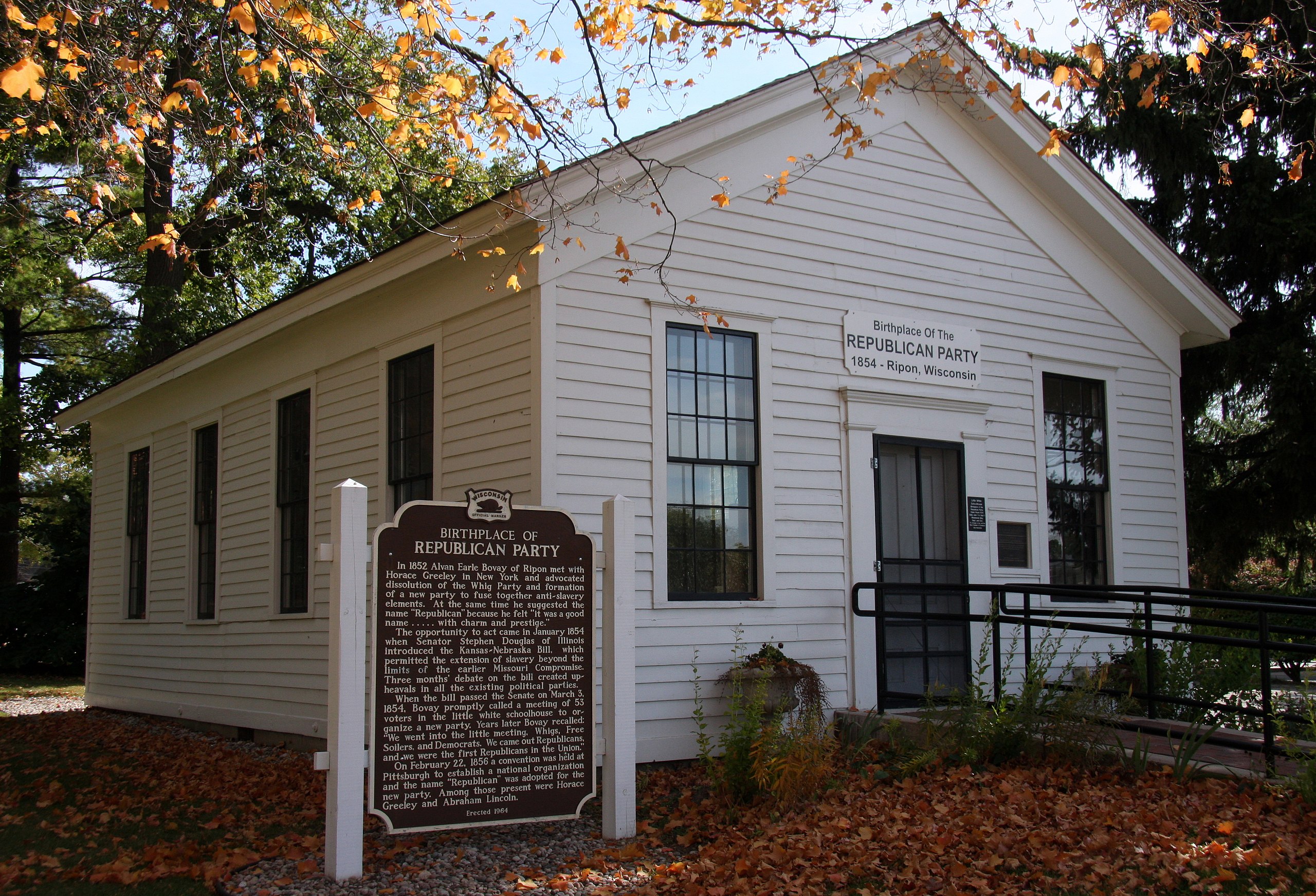
The predominant moral and political issue in the United States during the 1850s revolved around the institution of slavery (Photo Credit: Jonathunder).
Editor’s Note: This is a guest essay and does not reflect the views of The Indiana Commons or its editorial board. Others are welcome to submit guest essays on similar topics.
The Compromise of 1850, particularly the second Fugitive Slave Act, mandated citizens and officials in states that had abolished slavery to assist in the return of escaped slaves from the south.
In response to this, Harriet Beecher Stowe published Uncle Tom’s Cabin in 1852, which re-humanized those under slavery and highlighted the evils they were subjected to, including separation from family, torture, beatings, and the injustice of being treated as property without substantial rights.
Shortly after, in 1854, the controversial Kansas-Nebraska Act was passed, which allowed settlers in new U.S. territories to decide whether to permit slavery. Prior to this, the Missouri Compromise of 1820 banned permitting slavery above the 36º 30′ latitude in the largely unsettled western United States, which enabled an uneasy truce between anti-slavery and pro-slavery groups for years.
While the Whigs, one of the two major parties at the time, were focused on finding the right “balance’’ on the moral issue of slavery, the anti-slavery faction became convinced they weren’t sufficiently committed to ending the practice, and formed the Republican Party along with anti-slavery Democrats. Thaddeus Stevens, William Seward and Abraham Lincoln were among this number.
The anti-slavery Democrats, for their part published works such as the “Appeal of Independent Democrats in Congress to the People of the United States: Shall Slavery be Permitted in Nebraska?” in political newspapers across the country.
“Demagogues may tell you that the Union can be maintained only by submitting to the demands of slavery. We tell you that the Union can be only be maintained by the full recognition of the just claims of freedom and man,” the appeal stated.
The first meeting of the group which would later form the Republican Party took place in Ripon, Wisconsin in 1854. This developing third party had its first nominating convention in Pennsylvania in 1856.
Later that year, the Republican party presidential candidate John Fremont was defeated by pro-slavery Democratic candidate James Buchanan.
Around 33 % of the voters voted for the anti-slavery candidate John Fremont. There was also another third party, the “Know Nothing” party, which had a softer stance on slavery. Its candidate, Millard Fillmore, received 21% of the vote.
Voting for the most anti-slavery option instead of softening their position to remain united to other factions culminated in the election of Abraham Lincoln as the first Republican president of the United States and the recognition of the Republican Party as a major political party. Their persistence ultimately lead to the abolition of the scourge of slavery in the United States.
Nowadays, the intentional, premeditated killing of an unborn human being, or abortion, is the most pressing moral issue of our time.
In 1973, the Supreme Court decision Roe v. Wade ruled that abortion was a right protected by the U.S. Constitution. After this ruling, the pro-life movement has been on the forefront for advocating for the right to life.
In 2022, the Dobbs v. Jackson decision by the U.S. Supreme Court overturned Roe v. Wade, thus permitting states and the federal government to regulate or ban abortion.
As a result, the Democratic Party has staked their success on abortion extremism, reaching a point of advocating for the unlimited right to murder a child in the womb without government interference, changing significantly since the last pro-life Democratic president, Jimmy Carter.
The Republican Party was once considered an adequate defender of the pre-born, with a platform staunchly committed to a nationwide abortion ban. However, this changed earlier this year, when presidential candidate Donald Trump directed the GOP to remove mention of a nationwide abortion ban in the platform, in favor of a “leave it the states” approach, for the first time in decades.
As a result, many pro-life citizens and groups, long used to automatically assuming the GOP candidate is the pro-life choice, are seriously considering other political options, including a relatively new third party, which has a basic tenet of upholding the dignity of the human person from conception to natural death, the American Solidarity Party.
The American Solidarity Party has grown steadily since its founding in 2011. It is characterized not only by its staunch opposition to abortion, but also to its ideal of upholding the dignity of the human person from the beginning of life until the end, sometime called “pro-life for the whole life” approach.
To many, casting a vote for a third party candidate might just seem like a wasted vote. In a deeply blue state, a vote for a Republican candidate may also be considered a wasted vote. The same goes for a Democratic candidate in a deeply red state.
There are also large barriers to ballot access for third parties, thanks to the major parties, among other obstacles.
Fundamentally, however, a vote is a statement of one’s values and a moral decision just as much as it may be a pragmatic one.
While the American Solidarity Party may not win the presidency anytime soon, to many pro-lifers, just being able to vote their conscience is enough of a victory. Not to mention, when the ballots are counted at the end of the day, it may be that whatever modest success the American Solidarity Party has is what convinces the Republican Party that they need to do a lot more to earn the pro-life vote back.
Rene Trabanino MD/PhD is a family physician based in Los Angeles, CA.