
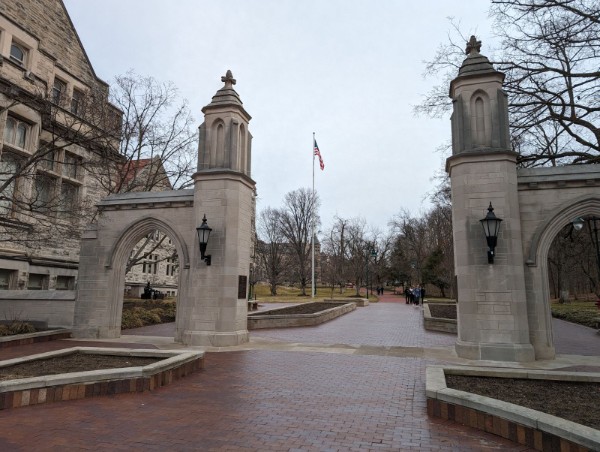
Indiana, since the drafting of its first Constitution in 1816, has put a great deal of emphasis on the importance of higher education. “Knowledge and learning generally diffused, through a community… [is] essential to the preservation of a free Government, and spreading the opportunities, and advantages of education through the various parts of the Country… [is] highly conductive to this end,” that founding document stated, providing the justification for funding a university system. The aim of this study, then, was to determine whether or not the current university system is effectively diffusing knowledge and learning throughout the communities of Indiana, or more directly, looking at the composition of the student body at Indiana University’s flagship campus, as well as the Kelley School of Business more specifically, including where students come from and where they go after graduation, as compared to similar state universities.
Comparing data with similar schools
54% of the Indiana University Bloomington 2023 freshmen class is from in-state.
78% of the University of California Berkeley student body is from in-state, and 76.22% stay in-state.
81.9% of the University of North Carolina – Chapel Hill student body is from in-state.
87.9% of the University of Illinois – Urbana-Champaign student body is from in-state.
90% of the University of Texas – Austin student body is from in-state.
| Indiana University (Class of 2023) | UC Berkeley | University of Texas at Austin | UNC at Chapel Hill | University of Illinois-Urbana Champaign | |
| Resident | 54% | 78% | 90% | 81.90% | 87.90% |
| Non-Resident | 46% | 22% | 10% | 18.10% | 12.10% |

Business Schools
At the McCombs School of Business at the University of Texas – Austin, there is a clear increase in the proportion of nonresident students as education level increases. The federal government is the largest funder of Research & Development at universities. Extremely specialized education is less likely to have state-specific benefits or to have job opportunities in-state.

| Undergraduates at McCombs (BBA Students): | |
| In State | 88.40% |
| Out of State | 6.00% |
| International | 5.60% |
| Graduates (Masters-level) at McCombs (MBA, MPA, MS): | |
| In State | 60.20% |
| Out of State | 18.00% |
| International | 21.80% |
| Doctoral students at McCombs (PhD) | |
| Instate | 11.30% |
| Out of State | 21.70% |
| International | 67.00% |
Kelley School of Business at IUB:


There is clearly a significantly lower proportion of in-state students at Indiana University Bloomington compared to the other state universities analyzed. A 2022 report by the Indiana Chamber of Commerce found that nearly 40% of Indiana college graduates move out of state within a year of graduation. This makes more sense with the context of major state universities choosing to give more seats to out-of-state students. There may be several reasons for this lower proportion of in-state students at Indiana University, part of which involves state policy.
Current Policy
The Indiana Commissioner for Higher Education’s State of Higher Education address recently highlighted the state’s policy to encourage partnerships between universities and businesses to ensure students are able to work internships during their college career and get an in-state job placement afterwards. However, that has been the State’s strategy since at least 2004, and retention appears to have gotten worse.
Indiana also participates in several programs that encourage out-of-state student enrollment, one of which was the Midwest Student Exchange Program, which equalized tuition rates between state universities in the Midwest. Illinois was one of several states in this program that recently moved to inactive status, as no colleges have opted in to the program.
Interestingly enough, UC Berkeley has an 11.3% acceptance rate, UT – Austin has a 29% acceptance rate, UNC Chapel Hill has a 17% acceptance rate, UI – Urbana-Champaign has a 43.7% acceptance rate (24.2% at their school of business), while IU Bloomington has an 80% acceptance rate.
Considering IU Bloomington’s high out-of-state student population, it is plausible that the relatively high acceptance rate primarily reflects the ease at which out-of-state students are accepted at the university.
Policy Proposals
Both Texas and Illinois state universities automatically accept the top ten percent of high school graduates. Illinois state universities also automatically accept community college students with at least a 3.0 GPA, so long as they have at least 36 credits. Both California and North Carolina have a cap on the percent of seats at state universities that can go to out-of-state students.
References:
https://www.mccombs.utexas.edu/
https://www.kenan-flagler.unc.edu/about/contact-us
https://kelley.iu.edu/doc/bloomington/deans/ksb-diversity-report-2021.pdf
State universities admit more out-of-state students for the tuition bump • Stateline
Supreme Court ruling could spark interest in Texas’ Top 10% Plan | The Texas Tribune