
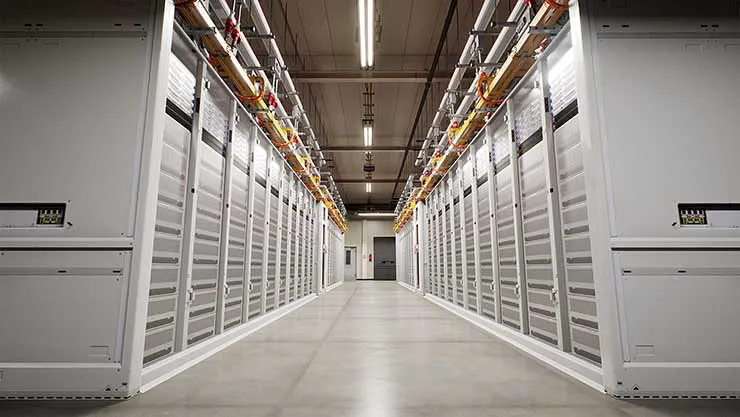
The market size of the artificial intelligence industry is expected to nearly quintuple between 2022 and 2027, but ChatGPT has already broken records for the fastest growing user base for a consumer application, answering around ten million questions every day. The computations behind the chatbot alone are estimated to use half-a-million kilowatt-hours of electricity, or enough to power 180,000 households, and a billion bottles of water per day (Photo Credit: Microsoft).
Several states have sought to cash in on the artificial intelligence boom with generous tax incentives for data centers. However, many of them are already net electricity importers, partially as a result of energy policies set at a federal level that make the use of coal difficult, meaning they may have a burgeoning energy crisis on their hands. The return of politically viable nuclear energy may be a long-term solution to meet their energy demands, but many roadblocks remain on the path towards a completely clean and reliable electrical grid.
Indiana is one such state considering this issue. It has had eight data centers set up shop over the past five years, and funding from the CHIPS and Science Act has directed millions to support industry in the state.
As a result, NIPSCO, a major utility company located in Northwest Indiana, estimates that six new data center projects in their service area could increase their peak load by 374% by 2035.
This increase comes as an addition to an already strained electrical grid.
Between 2010 and 2022, industrial use of coal in Indiana was cut in half and coal-fired electricity generation decreased from 89% to 52% of the total generation. In part because of the retirement of several coal plants, electricity production lagged behind demand even before data centers and semiconductor production facilities started migrating to the state.
Due to increased energy demand, Duke Energy has also delayed its plans to go completely coal-free by 2035 to 2038.
Renewable sources like solar and wind are less suitable to power data centers because of their unique energy demands.
“The challenge with… data centers and their power consumption needs is it’s not easily timed toward renewables,” said Dr. Gabriel Filipelli, Chancellor’s Professor of Earth Sciences and Executive Director of the Indiana University Environmental Resilience Institute. “Buildings, office buildings and homes… their peak demand tends to be in the late part of the day… that often still is a time when, if you’re fueling a grid off of solar, you’re getting pretty maximal solar output. So it matches well with the source, but… data centers run 24-7.”
Nuclear energy, on the other hand, runs continuously at high capacity on-baseload.
Three-Mile Island in Virginia is somewhat of a test case in the artificial intelligence boom making nuclear power politically viable again.
The plant was shut down in 1979 after a partial meltdown which led to political backlash against nuclear power. Now, however, the plant is planned to reactivate in 2028 to power Microsoft data centers.
“We’ve had an extremely restrictive regulatory environment for nuclear for quite a long time… [and] no new nuclear power plants have been built in like forever,” said Filipelli. “A lot of this is concern over nuclear safety, and that’s fine and all, but nuclear still remains…. far, far, far safer from a public health perspective than coal or natural gas.”
In terms of regulatory issues, large nuclear reactors like Three-Mile Island can take five to seven years to build and over a decade to get regulatory approval, which is too far in the future to seriously consider them to meet the demands of the grid today.
Small modular reactors (SMR), however, may present a more efficient way forward, as they can be built in less than two years, and the first units in the U.S. are expected to come online by the end of the decade.
Purdue University and Duke Energy partnered for a feasibility study on whether power produced through SMRs could be used to power their university back in 2022, which recommended federal and state policies that encourage reactor and workforce development in collaboration with the private sector and reduce the financial risks associated with reactor construction.
Soon enough, these reactors may be able to solve the energy demands of the artificial intelligence industry, but the energy demand is already high enough to make it difficult to justify continuing to move away from traditional energy sources like coal and natural gas.
While an all-of-the-above energy approach may be the most viable in the short-term while barriers to cheap and efficient nuclear energy are resolved, a completely clean energy grid that is able to meet the incredible demands of the artificial intelligence industry remains on the horizon.