
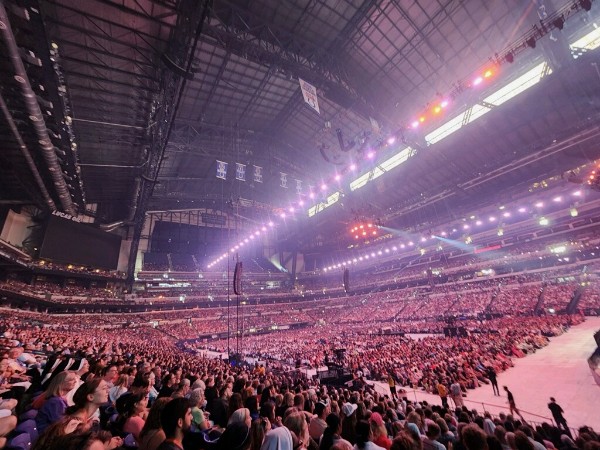
The 10th National Eucharistic Congress began in Indianapolis on July 17, lasting through this Sunday. It brought together over 50,000 Catholic pilgrims from around the nation to focus on the Eucharist, which was once a piece of typically unleavened bread, that has been consecrated by a priest and is believed by Catholics and some other Christians to be the body, blood, soul and divinity of Jesus Christ in a manner referred to as the “real presence.”
It is the first such Congress in 83 years, the last occurring in 1941, making it a historic moment for the church. The United State Council of Catholic Bishops (USCCB) deemed it critical after a 2019 Pew survey indicated only a third of Catholics actually believed in the real presence of the Eucharist. This event marks the pinnacle of a three year effort of Eucharistic Revival to change that.
The Eucharistic Revival began at a parish level, where individual churches focused on teachings of the Eucharist with their pastors and did parish-wide Eucharistic processions.
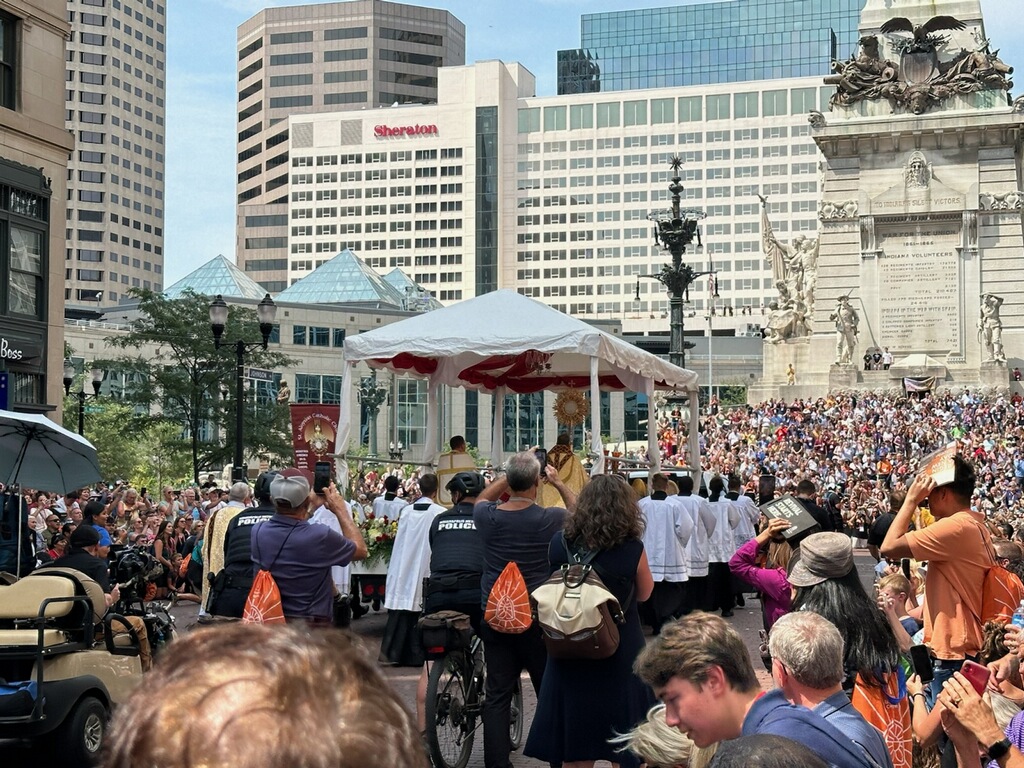
A Eucharistic Procession involves placing the Eucharist within a monstrance, which is typically a richly adorned glass case that often includes a cross on top. The monstrance is then lifted and carried by the bishop or priest who leads Catholics in a procession. This year in Indianapolis, several roads were closed for a Eucharistic procession downtown.
The procession is considered to be like a spiritual pilgrimage, beginning at a holy place, often a church, and ending at another, reminding Catholics of their journey towards eternal life.
The following year, the Eucharistic Revival went to the Diocesan level, involving Catholics in a district of the church under a bishop in Eucharistic adoration, processions, and educational gatherings.
Eucharistic adoration is prayer in front of a monstrance or tabernacle containing the Eucharist.
The third phase began at a national level on the weekend of Pentecost, which was on May 17th this year, when four Eucharistic Processions departed from the four cardinal directions of the United States, which would traverse across the plains of Texas, down the Mississippi, over the Appalachians and Rockies and meet in Indy 60 days later.
Pentecost is an important Christian holy day, as it celebrates the descent of the Holy Spirit on the church in Jerusalem while they were celebrating the earlier Feast of Weeks, as described in Acts 2.
The four processions included the St. Elizabeth Ann Seton Route, which began in New Haven, Connecticut, the St. Juan Diego Route, which began in Brownsville, Texas, the St. Junipero Serra Route, which began in San Francisco, California, and the Marian Route, which began at Lake Itasca, Minnesota.
Each walked nearly 10 miles a day, drove hundreds of miles, boated across rivers and oceans, and visited hundreds of parishes celebrating Eucharistic Revival with over 100,000 people.
Some smaller processions even occurred inside prisons, while larger ones like that which occurred in St. Paul, Minnesota, counted over 7,000 people.
The event
Some participants stood outside of the Indiana Convention Center for over two and a half hours just to receive their credentials for the first day of the event due to the large number of pilgrims that wrapped through and around the complex. That night, more than 50,000 of them made their way to Lucas Oil Stadium, where they introduced the perpetual pilgrims that walked all 60 days with each of their respective processional routes.
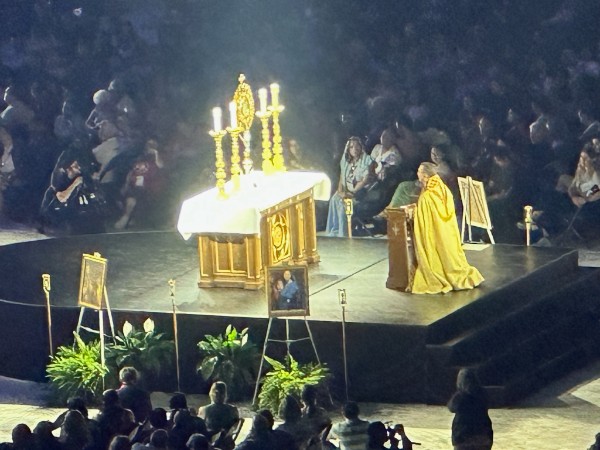
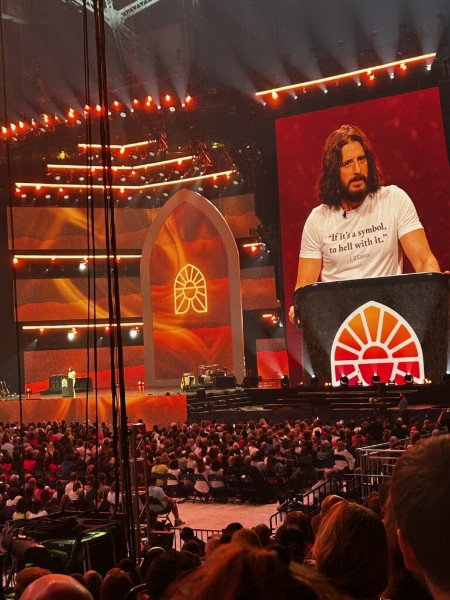
The attendees gave a roar of applause, as if they were star athletes. They then immediately went into a time of Eucharistic adoration, where a large monstrance blessed by Pope Francis was carried into the center of the stage.
Sister Josephine Garrett spoke and told the group that Congress means “walking together,” and many other leaders in the church spoke.
Prominent speakers included Father Mike Schmitz, the Sisters of Life, Scott Hahn, Trent Horn, Lila Rose, Monsignor James Shea, Cardinal Dolan, and Mother Golga, along with others who give testimonies of faith.
The rest of the Congress involved the Rosary, which is a type of prayer, participating in the Mass with thousands of priests and multiple bishops, singing songs of praise and worship to God, and going to a perpetual adoration chapel. Many Catholic organizations were present, and attendees had the option to visit and learn more about them.
Each night concluded with stadium-wide adoration of the Eucharist, or the Blessed Sacrament.
“If there is no Eucharist, there is no church,” Cardinal Dolan said.
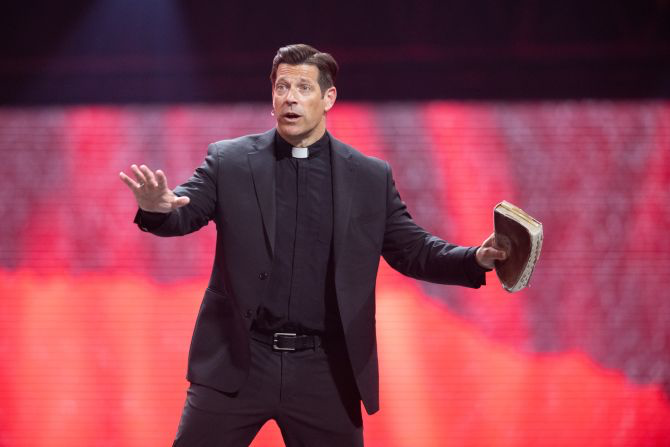
Father Mike Schmitz declared prior to a roar of the crowd and standing ovation that revival would be impossible without repentance, and that repentance required love.
“Knowledge can make someone great, but only love can make a saint,” he said.
Monsignor Shea spoke about how the Eucharist was the perfect food to alleviate spiritual famine, and bridge the “ancient curse” and “chasm” between individuals and God.
Mother Golga also spoke about the importance of the Eucharist, and how it enabled the communion of Christians that had passed with those still living. Instead of saying “see you in Heaven,” to loved ones, she said the attendees should say “see you in the Eucharist.”
Scott Hahn spoke the sacrifice of Jesus Christ on the cross for the sins of the world, and mentioned that the Eucharist makes the sacrifice of Christ “present,” arguing that if the Eucharist was not a sacrifice, then Christ’s death was just a Roman execution.
Father Spitzer said the Eucharist was intended by Jesus to be “His real body and real blood, which is the eternal sin offering to forgive our sins, liberate us from death, give us eternal life, provide us the most powerful weapon against evil, instill an absolute guarantee of His covenant, and make us a part of the family of His saints on Earth and in Heaven.”
The processional leading up to the Congress was compared to the events on the road to Emmaus, as described in Luke 24.
The first act of Jesus Christ after his Resurrection was to meet with two disciples, who did not recognize him, and spend hours teaching them everything there was to know about how he fulfilled the promises of the Old Testament, and how the Old Testament is revealed in the New, and the new is hidden in the Old.
They finally recognized him after he broke bread with them, only for him to disappear shortly after.
The leaders of the event pointed attendees to the words of John 6 (acted out by Jonathan Roumie, who played Jesus in The Chosen), 1 Corinthians 10, St. Ignatious of Antioch, St. Justin Martyr and others to strengthen their faith in the church’s teachings about the Eucharist and that it is the source and summit of their faith.
Speakers said the revival, like the Mass, was a calling to go out, repent in hope and joy, change their lives, and change the lives of others, so they too could be nourished by the Eucharist.
[RELATED: “Indianapolis Religious Organizations Guide”]
All of the talks from the event will be posted to Instagram, Youtube, and the National Eucharistic Congress website
Nicholas Mills is a Master’s of Business Administration student at Purdue Fort Wayne.