
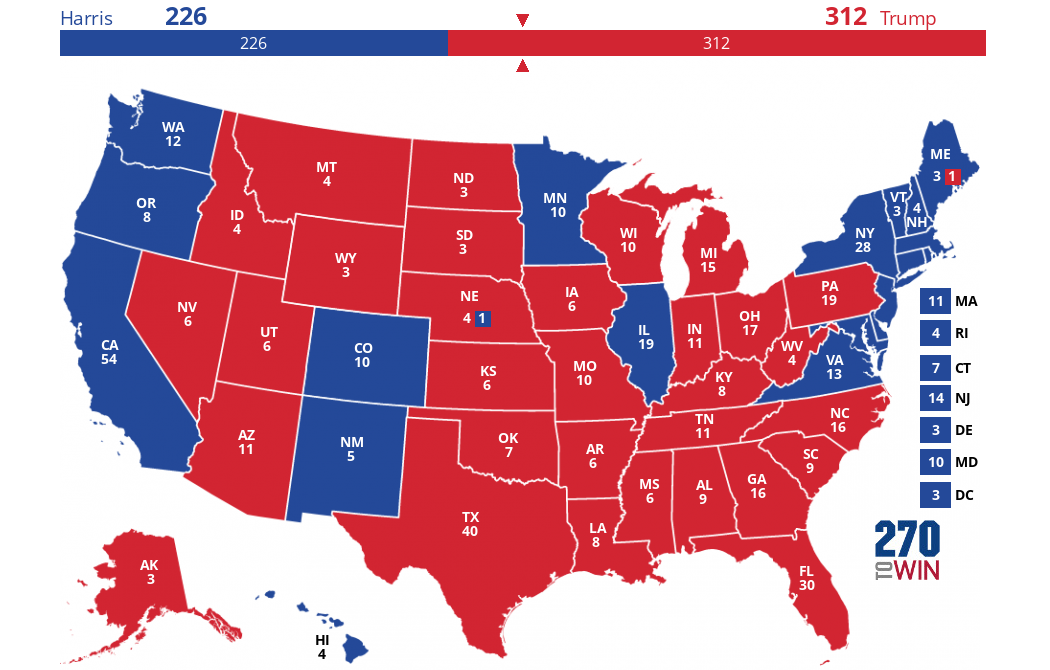
Alabama, like Indiana, tends to vote for Republicans for both statewide and local offices throughout the state. While Indiana has remained Republican throughout most of its history, despite brief stretches of Democratic dominance in statewide offices throughout the 1990s and early 2000s, Alabama was considered a Democratic stronghold from 1876 with the end of Reconstruction after the Civil War until the middle of the 20th century. While some have pointed to policy shifts in the major political parties for this change, a more direct explanation is backlash against the undemocratic tendencies of party machine politics. The backlash roughly mirrors that experienced by the national Democratic Party during the 2024 election (Photo Credit: 270ToWin).
During the presidential election of 1932, Franklin D. Roosevelt won 84.7% of the vote in the state, compared to Herbert Hoover’s 14.1%. Hoover, who was the incumbent president at the time, was at a disadvantage due to the Great Depression having begun closer to the beginning of his term. It was still surprising to many, however, that Roosevelt won by such a large margin in Alabama and the rest of the South, including neighboring Georgia, Tennessee and Mississippi. This was followed by more than a decade of statewide and local wins for Democrats in the state.
This period of uninterrupted success came to an end with the presidential election of 1948, which saw third-party candidate Strom Thurmond win the state’s electoral votes after Democratic electors were banned by their state party from voting for any candidate in support of civil rights, which included Harry Truman, the Democratic candidate who later became president.
Thurmond ran under the Dixiecrat Party, which split from the Democratic Party to oppose racial desegregation and civil rights more broadly.
The short-lived third-party quickly fell apart, returning the state to the Democratic Party, until 1964, when Senator Barry Goldwater, the Republican presidential nominee, would win the state’s electoral votes using similar rhetoric as Thurmond had 16 years prior, framing civil rights law as undue federal intervention.
This was the last year Alabama residents would vote for unpledged electors, a smaller group of people who then voted for the presidential candidate of their choice, rather than directly for the presidential nominees. These electors largely tended to vote based on the desires of the state party they belonged to.
In 1968, the popular former Alabama Governor George Wallace won the state as an independent candidate for president, again using similar rhetoric.
Republican Richard Nixon won the state during the presidential election of 1972 with 72%. of the vote.
Four years later, Democratic Governor Jimmy Carter would win the state back during the presidential election, but this would be the last time in modern history the Democratic Party would claim the state as a win.
Alabama would vote for their first Republican governor since Reconstruction in 1986. Like previous splits with Democratic candidates in the state’s history, this change was partially a result of state party machine politics. However, this time it was backlash against the perceived undemocratic nature of this system by the voters that led to longer-lasting change.
In this case, the primary result was invalidated 1 after a lawsuit in which Lt. Governor Bill Baxley claimed thousands of Republicans had “illegally” voted in the Democratic primary for Charles Graddick, who had encouraged them to. Graddick. for his part, argued they lived in an open primary state. The Democratic Party then removed Graddick from the ballot and replaced him with Bailey. Subsequent backlash gave Republican H. Guy Hunt an advantage that led to his election.
Republicans enjoyed an era of significant success in the state in the decades that followed, up until the present day.
Notably, the 2024 Indiana Republican gubernatorial primary also saw campaigns encourage Democrats to crossover and vote in the Republican primary. The same PAC responsible endorsed Brad Chambers for governor.
In recent decades, Democrats have had limited success in the state of Alabama outside of the urban 7th Congressional District, which often falls to the Democratic Party with 60% of the vote.
Much like the Alabama Democratic Party, the national Democratic Party was accused of being undemocratic during the last election after President Joe Biden dropped out of the race after winning the primary and Vice President Kamala Harris was installed by state electors without another primary.
As a result, she faired very well with donors, party machinery and the media but faired poorly with voters. She performed worse than President Biden did in 2020 in nearly every state.
Alabama’s history serves as a stark reminder that while machine politics may seem to benefit a party in the short-run, in the end the voters are likely to turn against a political party if it begins to emphasize maintaining power more than keeping a clean house and staying true to its principles.
This article should not be interpreted as an endorsement of any political candidate or party, and reflects the opinion solely of the author, and not The Indiana Commons or Collegiate Commons, Inc.
Jacob Buehrer is a sophomore at Purdue and the editor-in-chief of The Indiana Commons.
- http://Stovall, Cotter, & Fisher, Alabama Political Almanac, p. 260, 1995 ↩︎