
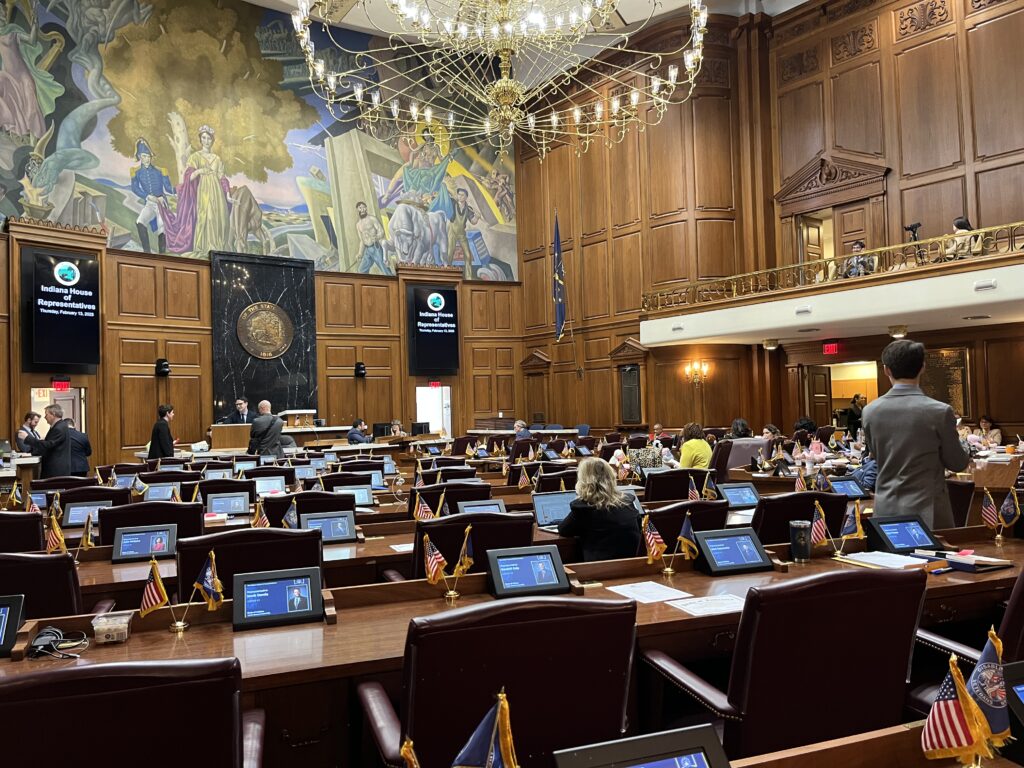
Republicans from the Indiana House of Representatives passed legislation aimed at bolstering Indiana’s energy independence through small modular nuclear reactors on Thursday, while the Indiana Senate rejected efforts to provide broader Indiana property tax relief.
[RELATED: House Republicans reject property tax relief effort for young families]
The House approved House Bill 1007, a wide-ranging measure that would allow utility companies to seek early cost recovery for small modular reactors (SMRs), before receiving full regulatory approval. The bill also offers a 20% state tax credit to SMR manufacturers, potentially attracting more advanced energy investments to Indiana.
Supporters say the legislation is a necessary step toward long-term energy affordability and grid stability, especially as the federal government and environmental lobbies push for the premature retirement of coal-fired plants.
According to the Indiana Capital Chronicle, Rep. Matt Lehman, R-Berne, defended the measure, saying, “When we talk about reducing energy costs, nuclear power is part of the answer. The more we build, the cheaper it gets.”
Currently, the United States has no operational SMRs. Globally, only China and Russia have deployed the technology. However, Rolls Royce—a major Indiana manufacturer—is exploring a 470-megawatt model.
Democrats, in contrast, raised concerns about the financial burden on ratepayers should projects be abandoned. Rep. Matt Pierce, D-Bloomington, criticized the bill as a “speculative venture” that risks turning everyday Hoosiers into “guinea pigs,” according to the Indiana Capital Chronicle.
The measure passed 67-25 along party lines.
Referendum Reform Prioritized
Lawmakers also advanced House Bill 1681, which restricts school referendum votes to general elections—a move widely seen as increasing electoral transparency and voter turnout. The bill aligns with Gov. Mike Braun’s conservative priorities for education and fiscal accountability.
“This ensures more Hoosiers have a voice in decisions that directly affect their taxes,” said Rep. Tim Wesco, R-Osceola, the bill’s author, according to the Indiana Capital Chronicle.
Democrats objected, claiming the change could make budgeting more difficult for local school districts, which rely on referendums to secure extra funding.
The bill passed 64-31, largely along party lines.
Senate Rejects Expanded Indiana Property Tax Relief
In recent years, homeowners have seen assessed values and bills surge at double-digit rates, making Indiana property taxes a key issue heading into the next election cycle.
While the House focused on future-oriented energy policy and voter empowerment, Senate Republicans stood firm against proposals that would have significantly expanded Indiana property tax relief—especially for renters and senior citizens.
Sen. Mike Young, R-Indianapolis, introduced an ambitious amendment to eliminate property taxes for all Hoosiers age 65 and older, regardless of income—modeled after programs in states like Alabama.
“Many seniors are being taxed out of their homes,” Young said. “This would give them long-overdue financial security.”
Despite support from six Republicans and nine Democrats, the amendment was rejected in a 15-31 vote. Critics, including Sen. Travis Holdman, R-Markle, objected to the lack of income testing, arguing it would provide unnecessary tax breaks to wealthy residents.
Another amendment from Sen. Fady Qaddoura, D-Indianapolis, sought to triple the renter’s tax credit from $3,000 to $9,000. The proposal was also defeated, with opponents citing its $27 million cost to state and local governments.
House of Representatives strips property tax relief bill, Senate concurs
UPDATE: The Senate concurred on the House of Representatives’ changes to Senate Bill 1 in the early morning of April 15 in a narrow 27-22 vote, with all support coming from Republicans. A few Republicans joined Democrats in opposing the measure, which offers Indiana homeowners a 10% tax credit on their property taxes, capped at $300. That means a homeowner paying $3,000 or more in taxes could see the full benefit—while others receive far less.
Despite its $1 billion price tag, some legislators argued the bill does little for working families already struggling with soaring costs. Instead, critics argue the bulk of the relief favors large businesses and high-assessment properties, doing little to address the root issues driving property taxes skyward, including a lack of new home construction.
Gov. Mike Braun, however, praised the bill, calling it a central promise of his Freedom and Opportunity Agenda.
“This is historic property tax relief,” Braun said in a statement. “Senate Bill 1 cuts property taxes for most Hoosier homeowners, farmers, and businesses… and makes the tax system fairer, more transparent, and easier to understand.”
The bill also opens the door for municipalities to impose a local income tax of up to 1.2% in addition to county local income taxes, which could hit all residents regardless of whether they own property. That means a taxpayer earning $100,000 could be on the hook for an additional $1,200 annually.
“This may help some, but it’s hardly the sweeping fix that was promised,” said one local taxpayer. “It’s like putting a Band-Aid on a broken leg.”
Sen. Travis Holdman, R-Markle, the bill’s author, called the legislation a necessary compromise between taxpayer relief and municipal budgets.
“We’ve struck a fair balance,” Holdman said. “This policy provides immediate relief and long-term reforms.”
Senate President Pro Tem Rodric Bray added that “this bill is absolutely a win for homeowners.”
Nevertheless, Hundreds of teachers gathered at the Statehouse April 14 to protest the legislation, warning that the bill’s funding shifts could remove hundreds of millions from public education over the next three years.
This article was based off the reporting of the Indiana Capital Chronicle and FOX59.