
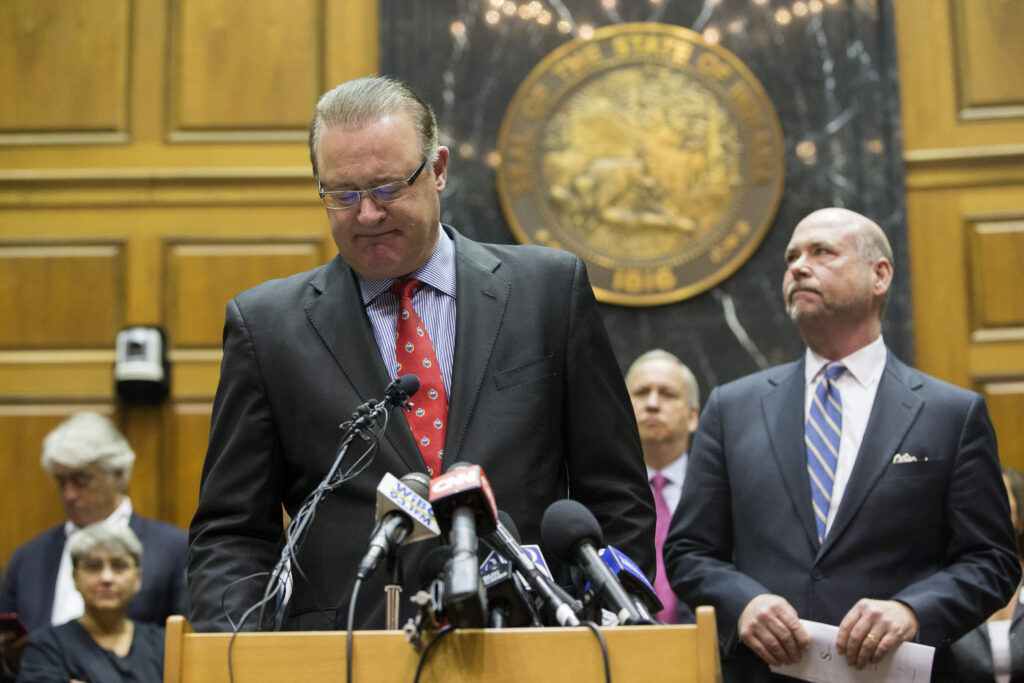
Indiana Senate President Pro Tem David Long speaks as House Speaker Brian Bosma (R) looks on during a press conference about anti-discrimination safeguards added to the controversial Religious Freedom Restoration Act at the State Capitol April, 2, 2015. (Photo by Aaron P. Bernstein/Getty Images)
“We didn’t start the fire,” singer Billy Joel tells us. “It was always burning since the world’s been turning.” Ten years ago today, however, Hoosiers started a new kind of flare-up that has been searing America’s political and social landscapes ever since.
The spark came on March 26, 2015, when then-Gov. Mike Pence signed the Indiana Religious Freedom Restoration Act (RFRA) in a “private ceremony” that created needless suspicion. In fact, RFRA was a law (full text here) nearly identical to laws previously passed in 18 other states, modeled on a 1993 federal law sponsored by Democrats and signed by President Bill Clinton.
Like the existing laws, Indiana’s RFRA established a legal defense for individuals against ordinances or legal actions that might force them to violate their religious beliefs. It neither mentions nor has anything specifically to do with gay marriage. In early 2015, however, as Americans awaited the Obergefell v. Hodges Supreme Court ruling, the involvement of some gay marriage opponents in the RFRA signing suggested a link.
A prominent Indiana University law professor (and gay marriage supporter) made clear several weeks before its passage that the law is “anything but a ‘license to discriminate.’”
The backlash
Hell broke loose in any case, centered on a claim spread by activists through social media that, yes, Indiana’s RFRA effectively licensed individuals and businesses to discriminate against people on the basis of their sexuality.
Traditional media outlets largely bought into it. As a national reporter told me at the time, what mattered was “what people believed.” CEOs, celebrities, basketball coaches—anyone with a Twitter account or a press spokesperson — echoed condemnation of a law that apparently none of them had read.
Foreshadowing much that was to come in America, facts and nuance took back seats to manufactured anger. Impassioned if badly misled protesters appeared at the Indiana Statehouse for tense standoffs, and unrest consumed Hoosier boardrooms, schools, and workplaces for days. Some other states — including Connecticut, which has the same law on its books — bizarrely instituted bans on government-funded travel to Indiana.
A small pizza shop was found in tiny Walkerton, where a member of the family that owned the shop said that they would not cater a gay wedding. Though no similar establishment in the state came forward or was found, signs appeared on the doors of countless other businesses declaring that “all are welcome,” as if all had not been welcome before.
Boycotts were threatened by businesses and convention sponsors, raising fears that the economic impact on Indiana could reach hundreds of millions of dollars. Pence made matters worse with an appearance on ABC News, during which he struggled to explain what RFRA did and didn’t do. He and other Republicans could have made clear that religious freedom and the rights of minorities have almost always gone together in free societies. In this instance, protecting religious freedom for a handful of dissenters made gay marriage more likely to be accepted by American society as a whole.
The legacy
In late March and early April 2015, however, the most strident voices carried the day, drowning out hope of reconciliation around a better social contract. Ultimately, the fires were quenched with a second law (Senate Enrolled Act 50) — also signed by Pence — stipulating that religious freedom is not a defense against legal actions alleging discrimination by a service provider. That constitutionally wobbly outcome advanced no one’s liberties while leaving behind seething tensions.
Yet for too many people, the main takeaway was to do it again.
After RFRA-like infernos, Indiana witnessed the brazenly unjust defenestration of leaders at Newfields and the Indianapolis Public Library. On other issues the benign “All Are Welcome” signs gave way to the arrogant “In This House” and “Slate of Hate” signs, which make every walk down the street a reminder of our troubled civil society. Hardly a legislative session in Indianapolis goes by without tribal protests that skirt consensus-seeking in favor of cheap slogans. And just as in 2015, no one’s circumstances get better as a result.
On matters as diverse as pandemic policies, Gaza, policing, abortion, and transgender youth, it has been like this across much of America since Indiana showed the terrible way.
On this somber anniversary, let us not be afraid to acknowledge what happened, muster our silent majorities, and seek an opportunity for renewal. Next time, we could show the rest of America how to put fires out rather than how to start them.
GET THE MORNING HEADLINES.
Gary Geipel